Nigerian Businesses Are Losing Millions to Manual Processes
A Computer Village electronics retailer was spending 4 hours responding to each WhatsApp inquiry manually. After automating responses, that dropped to 15 minutes. A multi-state logistics company automated dispatch across Lagos, Kano, and Port Harcourt — cutting processing time by 45% and eliminating tax compliance errors across states.
TL;DR: If approvals take days, your team copies data between tools, reports take a week, you've hired people just to manage processes, or customers complain about response times — you need workflow automation. Start with one process, one tool, and measure for 30 days.
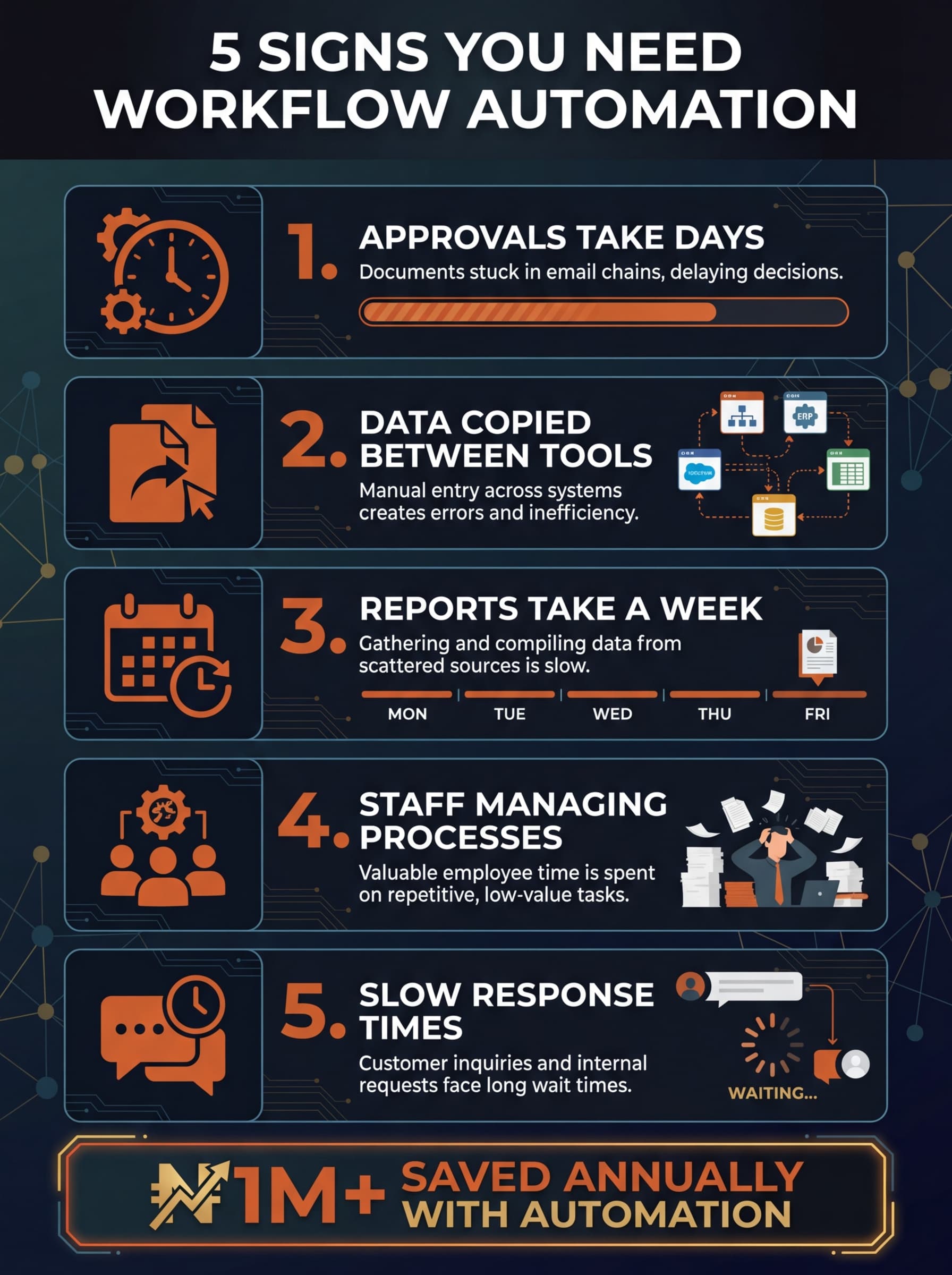
These aren't hypothetical scenarios. They're happening right now in Nigerian businesses that recognized the signs early. Here are the five clearest indicators your business is ready for automation.
1. Approvals Take Days Instead of Minutes
If a purchase order, leave request, or expense reimbursement sits in someone's inbox for 48+ hours, that's a systems problem — not a people problem. In a typical Nigerian mid-size company, approval chains involve 3-5 people across different locations. One person travelling to a site in Warri can hold up an entire chain.
What to implement: Multi-level approval workflows with automatic routing based on thresholds. A N500,000 purchase order routes to the department head; above N2 million, it escalates to the CFO. Tools like Flowmono (built in Nigeria) or Make.com handle this with drag-and-drop setup. No code required.
Budget approval workflows with automatic escalation reduce approval time from 5 days to same-day for most requests.
2. Your Team Copies Data Between Tools
When your accounts team manually transfers Paystack transaction data into QuickBooks every evening, errors multiply at every step. We've seen businesses where 12% of manually entered transactions had discrepancies — leading to week-long reconciliation marathons every month.
What to implement: API integrations between your payment processor and accounting software. Paystack webhooks can trigger automatic entries in QuickBooks, Zoho Books, or Sage. Zoho Flow connects Paystack to QuickBooks without writing code.
At a conservative value of N5,000/hour for your accountant's time, automating data transfer between just two systems saves N1,000,000+ annually from a N360,000 tool investment.
3. Monthly Reports Take a Full Week to Compile
If your finance team spends the first week of every month pulling numbers from five different systems — POS data from Moniepoint, sales from your CRM, expenses from Excel, payments from Paystack, payroll from BambooHR — you need automated reporting.
What to implement: Centralized dashboards that pull from all your data sources in real-time. Power BI connects to most Nigerian business tools. For simpler needs, Google Looker Studio is free and connects to Google Sheets, which can be auto-populated from your other tools.
Monthly reporting goes from a 5-day manual process to a live dashboard that's always current.
4. You've Hired People Just to Manage Processes
If you have staff whose primary role is data entry, status tracking, report generation, or chasing people for updates — automation can free them for higher-value work. A N30,000/month automation tool that saves 10 hours weekly is effectively a part-time employee costing N3,000/hour — far cheaper than hiring.
What to implement: Start with the most repetitive task. Common wins for Nigerian businesses:
- Automated invoice generation after delivery confirmation
- Employee onboarding document workflows (offer letters, NDAs, IT account setup)
- Inventory restock notifications when items hit minimum thresholds
Companies typically reassign 2-3 full-time roles to higher-value work after automating core processes.
5. Customers Complain About Response Times
95% of Nigerian customers use WhatsApp for business communication. If your response time is measured in hours, you're losing deals to competitors who respond in minutes. Slow internal processes — manual order confirmations, delayed payment verifications, queued support tickets — create slow customer experiences.
What to implement: WhatsApp Business API with automated responses for common queries (pricing, order status, business hours). Tools like Respond.io or WATI connect WhatsApp to your CRM and trigger automated workflows based on customer messages.
The Computer Village retailer mentioned earlier saw response times drop from 4 hours to 15 minutes — and a corresponding increase in conversion rates.
Your Action Plan: Start This Week
- Audit your top 5 processes — Time how long each takes manually. Multiply by frequency. The biggest number is your first automation target.
- Pick one tool — For most Nigerian SMEs, start with
Make.com(free tier available) orZapier. For document workflows, tryFlowmono. - Automate one workflow — Single-process automations take days to configure, not months. Start small.
- Measure for 30 days — Track time saved, errors reduced, and customer response improvements.
- Expand — Multi-department implementations typically take 6 weeks to 4 months.
NDPA compliance note: Whatever you automate, ensure it's configured for NDPA 2023 compliance — proper data handling, audit trails, and access controls. Non-compliance carries penalties up to N10 million.
At QodeUp Africa, we offer free workflow audits to help businesses identify exactly where automation will have the highest impact. No commitment — just a clear map of what's costing you money and how to fix it.