Nigeria's AI Moment Is Here — But Not How You Think
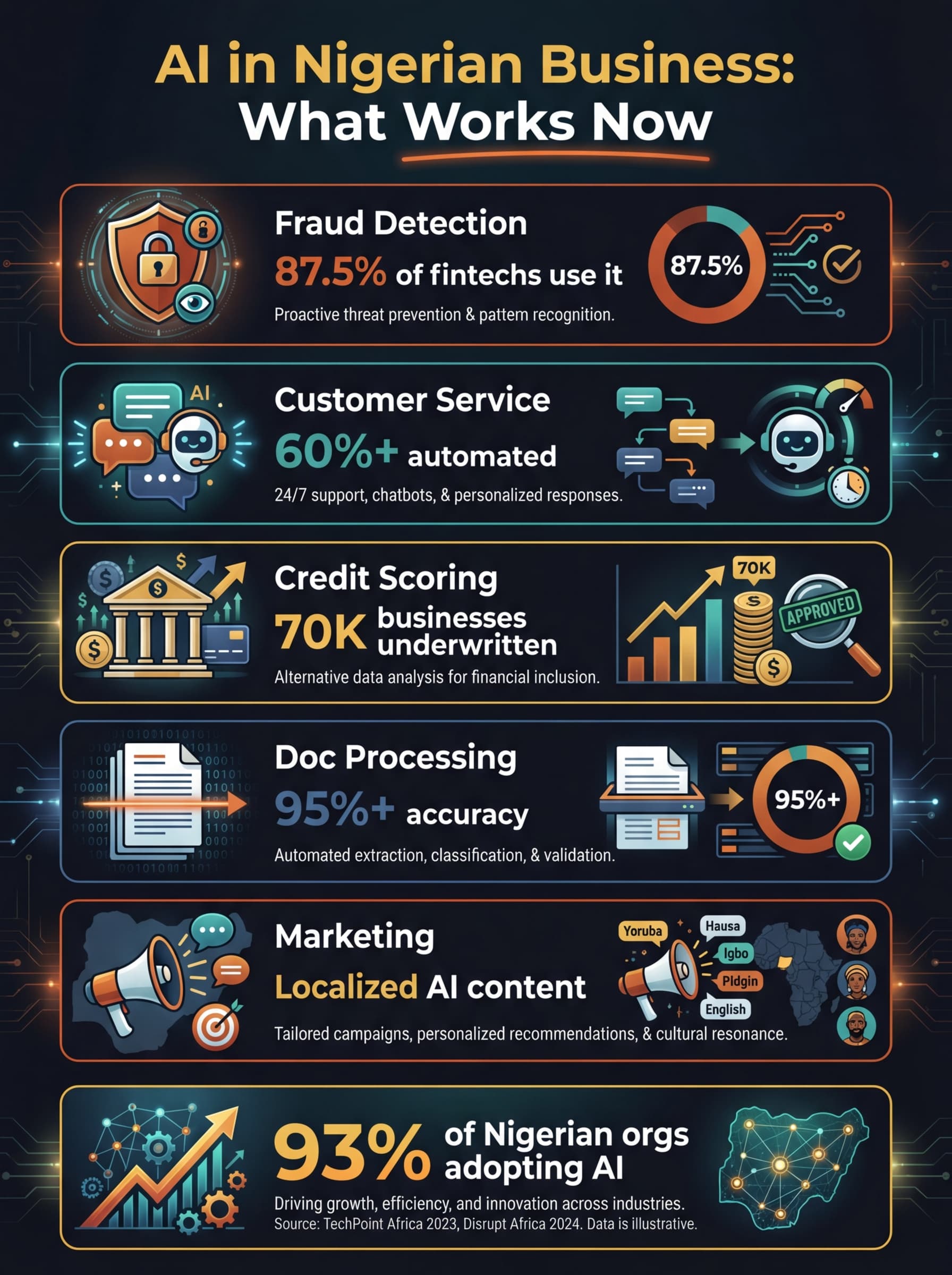
According to a 2025 Zoho survey, 93% of Nigerian organisations have begun adopting AI, with nearly one-third reporting advanced integration across operations. A Google/Ipsos study found 88% of Nigerian adults have used an AI chatbot — 26 points above the global average.
TL;DR: 93% of Nigerian organisations are adopting AI. The real ROI is in fraud detection (87.5% of fintechs), customer service automation (60%+ handled without humans), and credit scoring. Skip the hype — run a focused 90-day pilot against one measurable problem.
Nigeria's AI market is projected to grow from $1.40 billion in 2025 to $4.64 billion by 2030. But behind the headlines, the businesses seeing real ROI aren't chasing the flashiest AI — they're deploying it against specific, measurable problems.
Here's what's actually working, who's doing it, and how your business can start.
AI That's Delivering Real ROI in Nigeria Right Now
1. Fraud Detection — 87.5% of Nigerian Fintechs Use It
The Central Bank of Nigeria reports that 87.5% of Nigerian fintechs use AI for fraud detection. This isn't experimental — it's production infrastructure processing millions of transactions daily.
Kuda Bank trains its fraud detection model on tens of millions of Nigerian transaction patterns. Because the model is trained on local data, it catches fraud patterns that generic international tools miss. Result: false positive rates dropped by over 40%, meaning legitimate transactions flow without interruption while fraudulent ones get flagged.
For your business: If you process payments, fraud detection AI isn't optional — it's table stakes. Paystack and Flutterwave both offer built-in fraud screening. For custom systems, tools like Curacel (Lagos-based, working with 20+ insurers across eight countries) provide API-first fraud detection.
2. Customer Service Automation — 60%+ Handled Without Humans
Moniepoint reports that AI chatbots now handle over 60% of customer service inquiries without human escalation. The CBN survey confirms 62.5% of Nigerian fintechs use AI-powered chatbots for customer relations.This works because most customer queries follow patterns: "What's my balance?", "Where's my order?", "How do I reset my password?" AI handles these instantly, 24/7, freeing your support team for complex issues that require judgment.
For your business: Start with WhatsApp Business API + a chatbot platform like Respond.io or Freshchat. Train it on your top 20 most common queries. Measure what percentage it resolves without escalation. Most businesses see 40-60% automation within the first month.
3. Credit Scoring and Lending — AI Underwrites Where Banks Won't
Moniepoint uses machine learning to underwrite loans for 70,000 Nigerian businesses based on POS transaction patterns.Traditional banks require audited financials, guarantors, and collateral. AI can assess creditworthiness from real transaction data — opening lending to businesses that banks would reject.
For your business: If you're in lending or financial services, alternative credit scoring using transaction data, utility payments, and mobile money history is a proven application. Partner with providers who have local data models — international credit scoring algorithms don't work well in Nigeria's informal economy.
4. Document Processing and Data Extraction
AI can extract data from invoices, receipts, customs forms, and regulatory documents with 95%+ accuracy. For businesses processing hundreds of documents daily — importers, logistics companies, accounting firms — this eliminates hours of manual data entry.
For your business: Google Document AI, Amazon Textract, or Azure Form Recognizer all offer pay-per-page pricing. For a business processing 500 documents/month, costs run $50-150/month — a fraction of a data entry clerk's salary.
5. AI-Powered Marketing Content
Nigerian startups are using AI to produce localised marketing content — blog posts, social media copy, ad variations, and email campaigns. AI handles the volume; humans handle the strategy and cultural nuance.
For your business: Use Claude or ChatGPT for first drafts, but always have someone with local market knowledge review and adapt. AI-generated content that sounds like it was written for a US audience will fall flat with Nigerian customers.
Where AI Isn't Ready Yet (Don't Waste Money Here)
- Strategic decision-making: AI can surface data and patterns, but board-level decisions about market entry, hiring, and pricing need human judgment informed by local context.
- Deep cultural content: Pidgin English marketing, Nollywood-style video scripts, culturally sensitive communications — these require human creativity and cultural understanding.
- High-stakes decisions without oversight: Any application where errors have severe consequences (medical diagnosis, legal advice, loan approvals above a threshold) needs human review built into the workflow.
Practical Implementation: A 90-Day AI Pilot
Don't try to "become an AI company." Instead, run a focused pilot:
Days 1-7: Identify the Target
Pick one high-volume, rules-based process. Ideal candidates:
- Customer support queries
- Document processing
- Transaction monitoring
- Content generation
The process should have clear, measurable metrics (time per task, error rate, volume handled).
Days 8-30: Build and Deploy
Use existing AI tools — don't build from scratch. Connect via APIs:
- Chatbots:
Respond.ioorFreshchat - Document processing:
Google Document AI - Fraud detection:
Curacelor your payment processor's built-in tools - Content:
Claude APIorChatGPT API
Days 31-60: Measure Everything
Compare against your baseline: How many queries does AI resolve vs. humans? How many documents processed per hour? What's the error rate? What's the cost per transaction?
Days 61-90: Decide and Scale
If ROI is positive, expand to the next process. If not, you've learned what doesn't work at low cost. Either way, you now have real data — not vendor promises — to guide your AI strategy.
The Nigeria-Specific Edge
Nigeria's unique advantage in AI: the problems are big enough to justify the investment, and the solutions don't exist yet for the local market. Businesses building AI solutions trained on Nigerian data — Nigerian transaction patterns, Nigerian languages, Nigerian business processes — have a moat that international competitors can't easily cross.
If 2025 was about proving AI works, 2026 is about who scales it first.