The Real Numbers Nobody Talks About
Here's the question every growing Nigerian business faces: keep managing customers in spreadsheets and WhatsApp groups, buy a CRM like Salesforce or HubSpot, or build something custom? The answer isn't obvious — and the wrong choice costs real money.
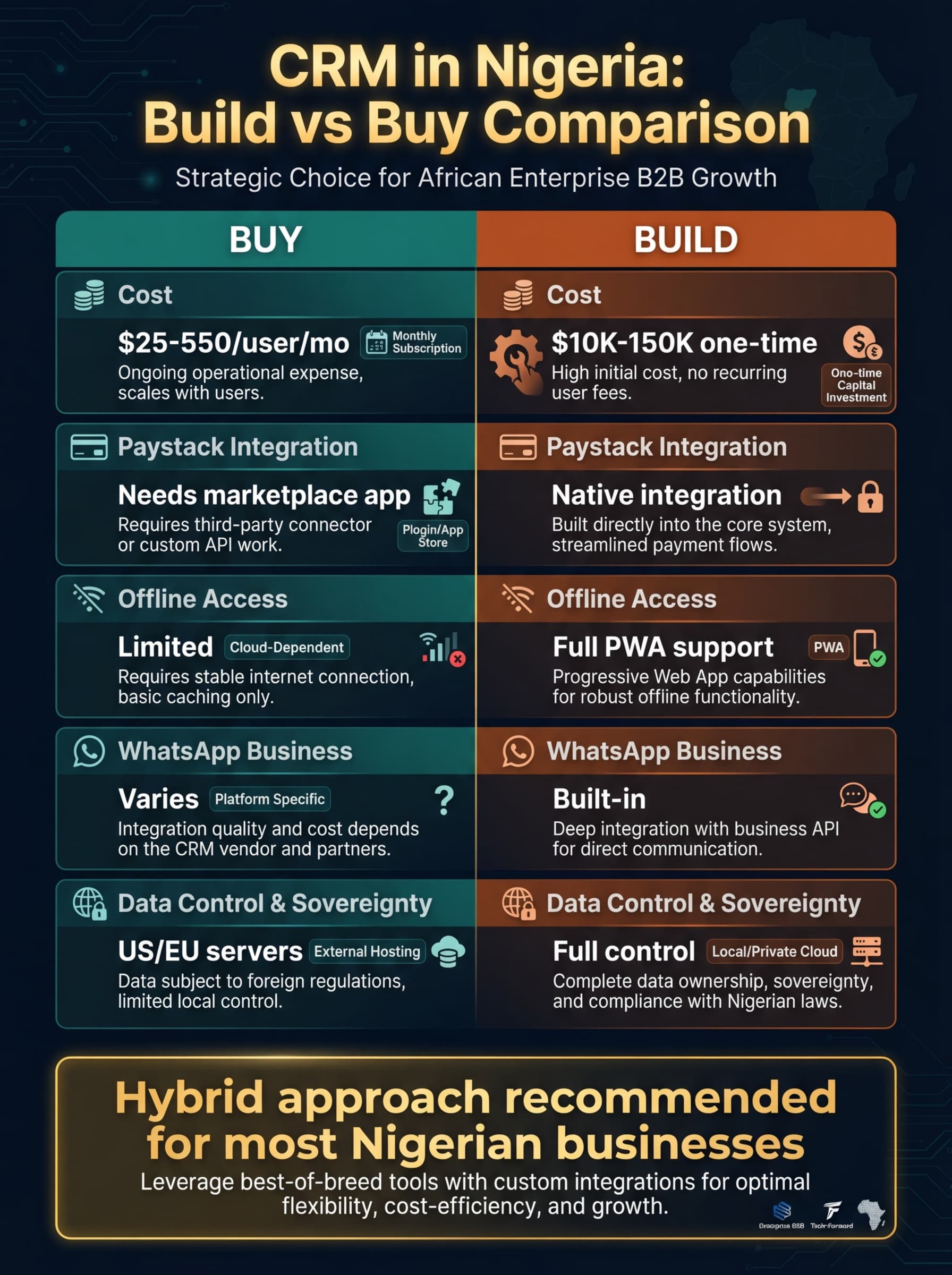
TL;DR: Salesforce runs N38M+/year for a 20-person team. Custom CRM starts at $10,000. For most Nigerian businesses (10-100 employees), the sweet spot is a hybrid: custom CRM for unique workflows + standard tools via API for email, accounting, and analytics.
Let's break down actual costs, local factors that international guides ignore, and a decision framework you can use today.
Option 1: Buy Off-the-Shelf (The Pricing Reality)
Salesforce (2026 Pricing)
- Starter Suite: $25/user/month — basic contact management, email integration
- Pro Suite: $100/user/month — customization, automation, forecasting
- Enterprise: $175/user/month — advanced analytics, workflow automation
- Unlimited: $350/user/month — everything, plus AI features
A 20-person sales team on Pro Suite = $2,000/month = $24,000/year = roughly N38 million/year at current rates. And Salesforce raised prices 6% in 2025, with another 5-7% hike expected in 2026.
Hidden costs: Salesforce implementation typically requires consultants ($150-300/hour). Customization beyond basic setup doubles your first-year cost. Data migration from spreadsheets is always harder and more expensive than quoted.
HubSpot
- Free tier: Contact management, deal tracking, pipeline board, up to 1 million contacts — genuinely free forever
- Starter: $20/user/month — removes HubSpot branding, adds more features
- Professional: $100/user/month — full automation, sequences, reporting
HubSpot's free tier is the best starting point for any Nigerian startup. It's legitimately useful, not a crippled demo. Start here and only upgrade when you hit a wall.
Zoho CRM
- Free: Up to 3 users
- Standard: $14/user/month
- Professional: $23/user/month
Zoho is the strongest value play for Nigerian startups that need customization without breaking the bank. It's also the easiest to integrate with other Zoho products (Zoho Books, Zoho Invoice, Zoho Flow).
Option 2: Build Custom (The Development Reality)
What Custom CRM Development Actually Costs
- Basic CRM (contact management, pipeline, basic reporting): $10,000-25,000 / 4-8 weeks
- Standard CRM (automation, integrations, dashboards, mobile): $25,000-50,000 / 2-4 months
- Enterprise CRM (multi-tenant, AI features, complex workflows): $50,000-150,000+ / 4-8 months
Ongoing maintenance: budget 15-20% of development cost annually for updates, bug fixes, and feature additions.
The Nigeria-Specific Decision Factors
International build-vs-buy guides miss critical factors for Nigerian businesses:
1. Paystack/Flutterwave Integration
This is the dealbreaker. HubSpot, Zoho, and Salesforce can connect to Paystack — but it's not native. You need marketplace apps or custom integrations that add complexity and cost. CRM Africa (a Nigerian CRM) offers out-of-the-box Paystack and Flutterwave integration with zero custom coding.
If payment tracking inside your CRM is critical (it usually is for Nigerian businesses), this single factor can tip the decision toward custom or local solutions.
2. Offline Capability
Field sales teams in areas with spotty connectivity need to access and update customer data offline. Most SaaS CRMs require constant internet. Custom-built Progressive Web Apps (PWAs) can cache data locally and sync when connection returns — essential for teams operating outside Lagos and Abuja.
3. WhatsApp Integration
95% of Nigerian B2B communication happens on WhatsApp.
Your CRM must connect to WhatsApp Business API for logging conversations, sending automated follow-ups, and tracking deals. This is trivial in custom builds but varies widely in off-the-shelf options.
4. Naira Pricing and Local Tax
SaaS CRMs price in USD. Exchange rate fluctuations mean your CRM cost can jump 20-30% in a year without any feature changes. Custom solutions have fixed development costs and local hosting options.
5. Data Sovereignty
NDPA 2023 compliance means you need to know where your customer data is stored. International CRMs store data on US/EU servers. Custom solutions give you full control — host in Nigeria if required.
The Decision Framework
Buy HubSpot Free if: You're a startup with fewer than 10 salespeople, standard B2B sales process, and no complex integration needs. Start free, upgrade when you hit limits.
Buy Zoho CRM if: You need 3-50 users, want affordable customization, and use other Zoho products. Best value in the mid-market.
Buy Salesforce if: You're an enterprise with 100+ users, need global operations support, and have budget for implementation consultants. The per-user cost is high but the ecosystem is unmatched.
Build Custom if: Your workflow is non-standard (church management, school admissions, multi-state logistics), you need deep Paystack integration, offline capability is required, or Salesforce licensing over 3 years exceeds custom development cost.
The Hybrid Approach (Our Recommendation)
For most Nigerian businesses in the 10-100 employee range, the sweet spot is a lightweight custom CRM for your unique workflows (payment tracking, offline-capable field forms, WhatsApp integration) connected via APIs to standard tools for email marketing (Mailchimp/Brevo), accounting (QuickBooks/Zoho Books), and analytics (Google Analytics/Mixpanel).
You get a system that fits your business exactly, costs less than enterprise licensing, and gives you the flexibility to evolve as your needs change.