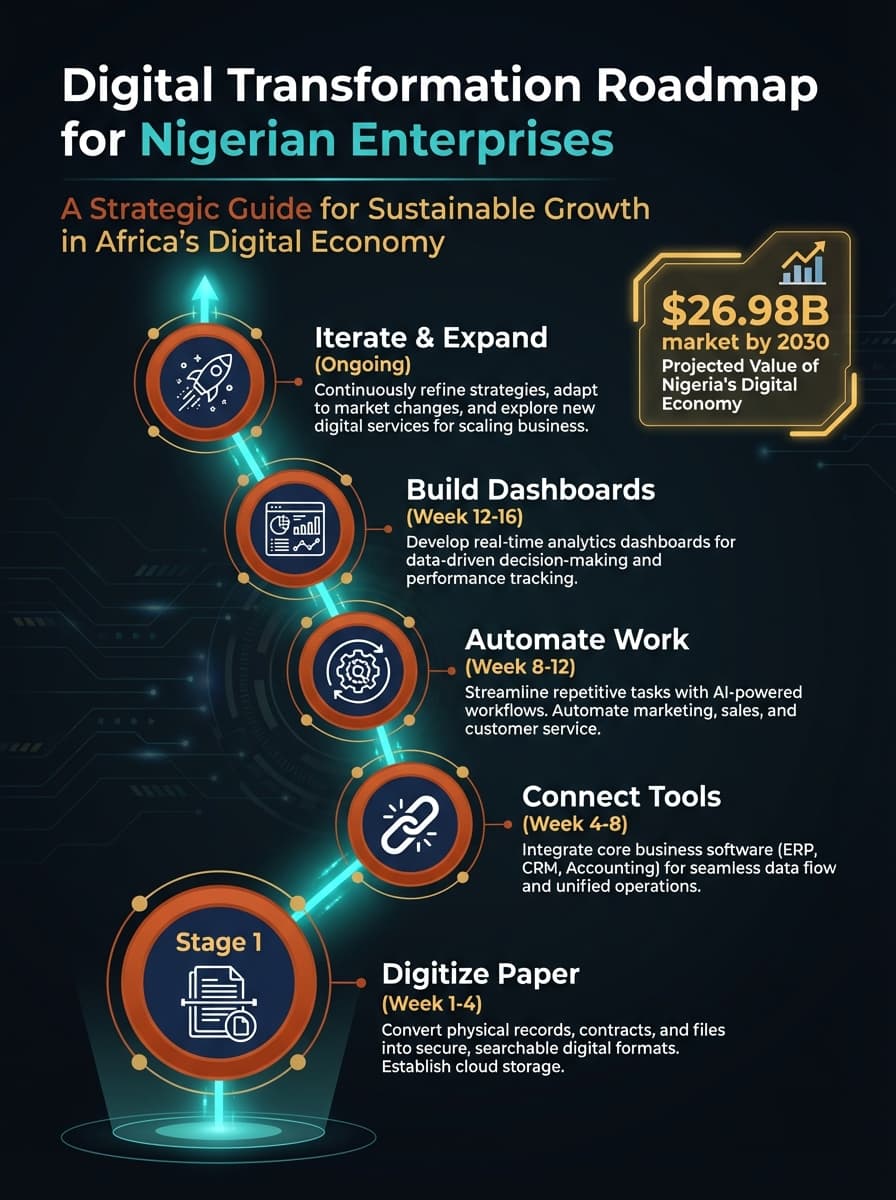
A $26.98 Billion Opportunity — And Nigeria Is at the Centre
Nigeria's digital transformation market is projected to reach $26.98 billion by 2030, growing at 18.17% annually. The country's digital economy is set to hit $18.3 billion by the end of 2026. These aren't abstract projections — they represent real revenue flowing to businesses that digitize and away from those that don't.
TL;DR: Nigeria's digital transformation market hits $26.98B by 2030. Success requires a Nigeria-specific approach: offline-first, mobile-first, local payment integration, and a phased 5-stage roadmap. SMEs with higher digital adoption see 15% revenue growth vs. under 5% for laggards.
But digital transformation in Nigeria looks different from Silicon Valley playbooks. Here's what it actually means for your business, the unique challenges you'll face, and a practical framework to start.
What Digital Transformation Actually Means
Digital transformation is not buying new software. It's fundamentally rethinking how your business operates using digital capabilities. The distinction matters: you can spend millions on tools and still operate exactly the same way.
Real transformation means: a logistics company that moves from paper manifests to real-time GPS tracking and automated dispatch. A bank that replaces branch queues with mobile-first services. A manufacturer that uses sensor data to predict equipment failures before they happen.
Nigerian SMEs with higher digital adoption reported 15% revenue growth, while those with lower adoption saw gains below 5%.
The Nigerian Context: Why Generic Playbooks Fail
Every digital transformation guide assumes reliable internet, stable power, and a workforce comfortable with laptops. Nigeria's reality is different, and your strategy must account for it.
Connectivity: Build for Offline First
Broadband penetration stands at about 48.81% nationally, and only 23% of rural communities have internet access.
Your systems need offline capability — Progressive Web Apps that cache data locally and sync when connectivity returns. Field teams in Warri, Kano, or Port Harcourt can't wait for a stable connection to complete a transaction.
Mobile-First Is Not Optional
Smartphone penetration reached 64% in 2025. Your workforce and customers are on mobile.
Any system that requires a desktop browser to function will see poor adoption. Design for small screens first, then scale up.
Power Infrastructure
Cloud-native systems with automatic state saving protect against power interruptions. Ensure every form, transaction, and workflow can resume exactly where it left off. An eight-location electronics chain implemented offline-capable automation with zero revenue loss during outages.
Payment Integration
Any customer-facing system must integrate with local processors — Paystack, Flutterwave, Moniepoint — alongside international gateways.
Paystack alone processes payments for over 200,000 businesses across Africa.A Practical Framework: The 5-Stage Roadmap
Successful transformation follows a clear pattern. Do these in order — each stage builds on the previous one.
Stage 1: Digitize Paper Processes (Week 1-4)
Move forms, approvals, and records from paper/WhatsApp to digital systems. Start with the process that creates the most bottlenecks. Common wins: expense approvals, leave requests, purchase orders, customer intake forms.
Tools: Google Workspace (affordable), Flowmono (Nigerian-built), or Zoho One (comprehensive suite).
Stage 2: Connect Your Tools (Week 4-8)
Integrate your existing software so data flows automatically. The goal: enter data once, and it appears everywhere it's needed. Connect your POS to your accounting software. Connect your CRM to your email marketing tool. Connect your HR system to your payroll.
Tools: Make.com, Zapier, or Zoho Flow for no-code integrations.
Stage 3: Automate Repetitive Work (Week 8-12)
Use workflow automation to eliminate manual tasks that follow predictable rules. Invoice generation, payment reminders, status updates, report compilation — anything your team does the same way every time is an automation candidate.
Tools: n8n (self-hosted, no per-workflow fees), Make.com, or custom automation with Node.js/Python.
Stage 4: Build Dashboards (Week 12-16)
Give leadership real-time visibility into operations. Replace monthly spreadsheet reports with live dashboards that update automatically. Start with the 3-5 metrics your CEO asks about most.
Tools: Power BI (connects to most Nigerian business tools), Google Looker Studio (free), or custom dashboards with React + D3.js.
Stage 5: Iterate and Expand (Ongoing)
Use the data from your dashboards to identify the next highest-impact area. By this stage, you have the infrastructure to digitize new processes in days, not months.
Common Mistakes Nigerian Businesses Make
- Trying to transform everything at once. Start with one department or one process. Prove the value, then expand. Multi-department implementations take 6 weeks to 4 months — plan accordingly.
- Choosing tools before understanding workflows. Technology should follow process design. Map how work actually flows (not how the org chart says it should) before selecting any tool.
- Ignoring local support. Local vendors offer better contextual understanding and faster support during Nigerian business hours. International platforms may have more features, but a tool you can't get help with is a tool you'll abandon.
- Skipping change management. The best system in the world fails if your team doesn't use it. Budget for training. Assign internal champions. Make the first 30 days easy.
- Neglecting security. Cyberattacks cost the Nigerian financial sector over N67 billion in 2024. Every digital system needs proper access controls, encryption, and regular security audits from day one.
The Cost of Waiting
Nigeria's government is investing heavily in digital infrastructure — the 3 Million Technical Talent programme is growing the pool of digitally skilled professionals, and the NUCAP Towers Programme is deploying 3,700 telecommunications towers to expand connectivity. The infrastructure is improving rapidly.
Businesses that invest in digital transformation now will ride this wave. Those that wait will find themselves competing against digitally native competitors with lower costs, faster service, and better data. The market doesn't wait for laggards.